From Buratino's Notes
A necessary clarification: Buratino is a counterpart to the Italian Pinocchio, created in Soviet Russia by the writer Alexei Tolstoy. Buratino has a different character and, overall, a deeper emotional and moral personality.
1
From Buratino's Notes, When Papa Carlo Passed Away and the Hurdy Gurdy Was Soaked, The candle flame went out, and I fell asleep right at the table, on the scribbled sheets of paper... It was a beautiful starry night in mid-July. Suddenly, someone touched my shoulder and quietly said, "Let's go." I raised my head, but the room was empty. Overcoming myself, I stood up, undressed, and lay down on the sofa. A marvelous moon shone, and the phosphorescent hands of the clock showed a quarter to three. Sleep overcame me, and again I felt the touch of someone's hand and a voice: "Well, what are you doing? Let's go."
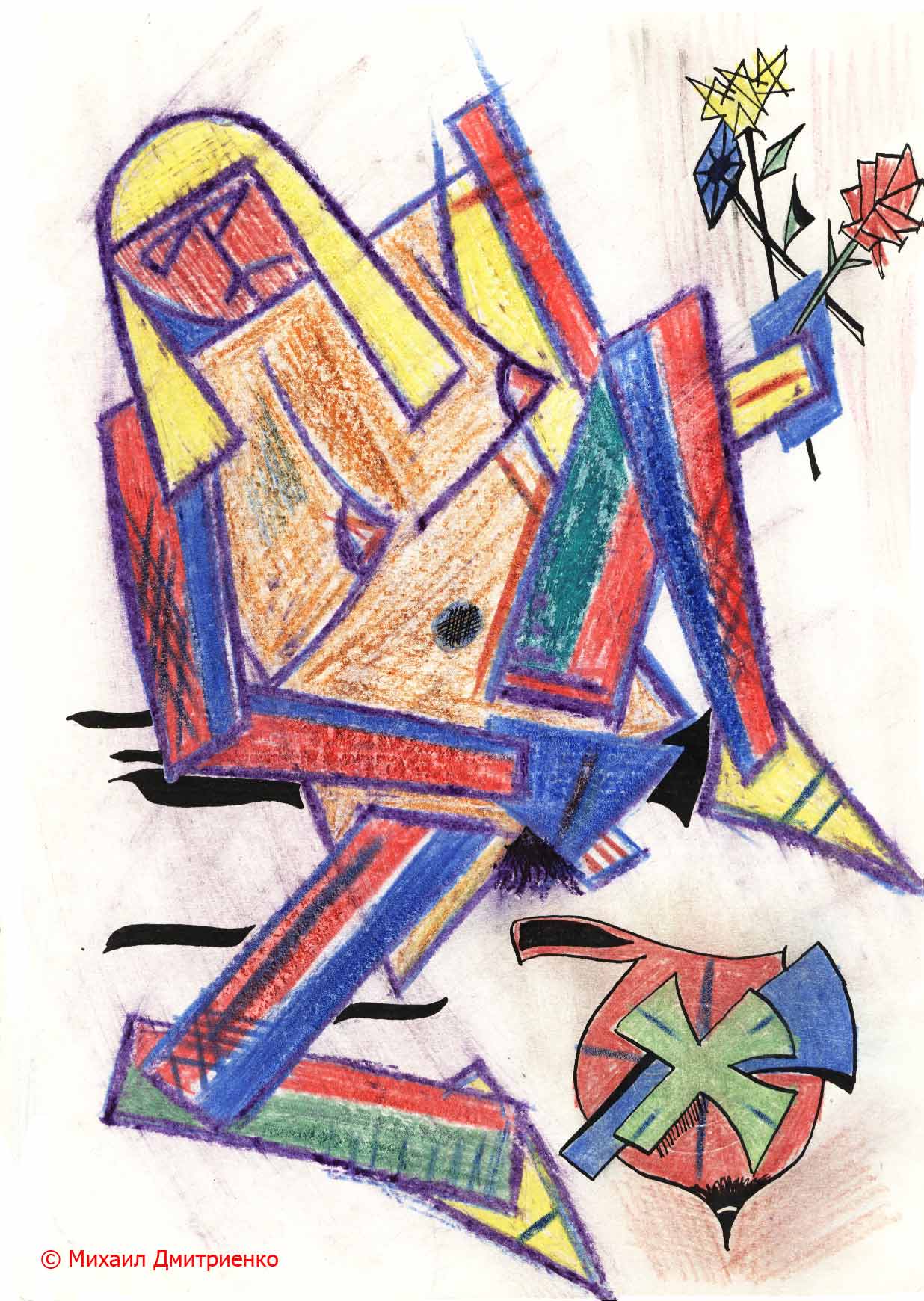 "Who are you?" I asked in a whisper. A completely auditory hallucination answered: "Who are you?" I asked in a whisper. A completely auditory hallucination answered:
"I am a messenger from Other Worlds." "Yes, yes... I know..." I whispered to myself, and, wrapping my head in the blanket, I thought I needed to introduce some kind of restraint into my chronic alcoholism.
It had been like that before, especially when the disgusting-tasting "Armoise Wormwood Bitters" came on the market. It was a pitiful imitation of absinthe, and the only attractive thing about it was its low price.
Back then, when my liver was functioning normally, my teeth weren't crumbling, and my memory was capable of retaining more than just the bad stuff, I'd write 10-20 pages. I'd barely even finish a finished novel before the idea for two or three new works would consume me completely. I didn't resort to candles back then — my inspiration didn't need artificial stimulation. Quite the contrary — I'd stifle the frenzied work of my creative mind with sleeping pills, and more often than not, with plain alcohol. My family told me alcoholism was a hereditary affliction, but that's unlikely...
Someone knocked on the door; the late-night visitor, apparently out of delicacy, didn't want to press the doorbell, which, frankly, wasn't working anyway. Cursing out loud, I peered through the bleary peephole in the door — the dimly lit entryway was empty. I'm not a fan of such things; it's not for nothing that everyone calls me a gloomy recluse, and behind my back, they call me "a crackpot" or "a hooligan" (surely there's something there). I perked up and, in addition to my own heartbeat, heard someone's hoarse breathing.
"Who's there?" I asked, in as low and confident a voice as I could. "What do you need?"
The breathing behind the door stopped, and no one answered. "The hell with you, it's late, I'm going to bed," I said, pretending to move away from the door and keeping quiet. I can be silent when necessary, and Nature herself has taught me how to hide.
Perhaps five minutes passed — there was no sound behind the door, and the entrance, through the peephole, looked completely empty. Maybe they were hiding on the other side, too? — but I forgot everything and went into the kitchen, where, without turning on the light, I lit a cigarette.
The water pipe began to hum, and simultaneously I heard another knock, this time from the window, and the scraping of a fingernail on the glass. I was both angry and scared — some of those ancient superstitions still clung firmly to my mind. Standing in the middle of the room, I distinctly heard the light bulb above my head creak and begin to crackle quietly. The thin filament glowed faintly. The semi-darkness lit up, casting incredibly distorted shadows in all directions, like black cloaks.
I woke to a light touch and a female voice speaking directly into my ear, "Let's go." The room was filled with a ringing silence, and the more I listened, the louder it rang, filled with whispers, giggles, and tapping sounds. Suddenly, someone climbed onto my blanket with light steps. I used to have a cat; it used to jump up and walk all over me while I slept, but now, for over ten years, the cat has been gone...
With an effort, I stood up and, flicking the switch, looked around; the bright light blinded me—I was completely alone. I walked into the kitchen, turning on all the available lights along the way — everywhere there was complete silence — I was alone. Remembering that there was a half-empty bottle of vodka in the fridge, I was glad I hadn't finished it off that evening. Now I'd have something to calm my frayed nerves with.
For over ten years now, I've been living alone — completely alone. Somewhere out there, very far away, lives my sister, my brothers, but they're so busy with their own affairs that they have no time for me; ten letters — ten years... I remember with a smile how the mere thought of being left like this — alone — once filled me with numb fear, and I vowed to myself to die as soon as that ominous hour struck. It's funny — I knew down to the smallest detail what would happen and how — I thought I knew EVERYTHING! Yes, that's right — I really did know everything.
I preferred to endlessly bang my head against the wall, even though I knew the wall could be circumvented. I even knew where convenient doors, cunning loopholes, and long-trodden breaches were. People invited me, beckoned, and practically dragged me along by force. But my calculations were so simple and correct that I became arrogant, ashamed to follow such paths. After all, my path led to only one of two things: either I break the wall or I break my head ("the wall breaks my head" is an incorrect expression). And now, from the "height" of today, I see the wall intact and feel my head intact and undamaged. What happened, where did I go wrong?
I truly followed the lead of my heart, my Self, or what is called the "core of a person." But I'm still at that wall, while others are farther away, higher up, and, incomprehensibly, happier...
I wasn't lying when, at 24, I raised my hand against myself for the first time. Then I was dumped, dumped by the girl I thought I loved. This has happened before and, alas, later. The story is so trivial that it's embarrassing to tell, let alone admit...
There were other things, too, but hardly anyone would call a sober-drunken frenzy a suicide attempt. However, I did many things that would be commonplace for others, according to the laws of "Russian roulette," and, heading out into the darkness of the city at night, I committed suicide — a 50/50 chance, alas, again, "alas!" One-sided luck limped along at my heels. Now I've cooled down, and even after drinking too much, I don't indulge in flirting with death, but — nothing else either... My motto: "Water runs from the tap — no reason, it's just a matter of chance — turning it off."
I've long since left my city and live in the middle of nowhere; finding me would probably be difficult even for the police. And who would recognize the round-faced Mishanya who smiled naively at everyone in this stooped, rather balding old man? What I wrote has long been forgotten, long abandoned, and lost. What I write now could be called an old man's pastime — a doomed waste of ink. I know this, and that's why I take out the trash myself.
2
When moving from one imaginary world to another, it's very easy to lose your own, real world— every writer should remember this, and I considered myself a sober-minded writer. This didn't mean I wasn't intoxicated by the love of my characters; it only meant that I always remained, as it were, on the sidelines. Consigning your characters, even fictional ones, to absurd and horrific deaths is a simple matter, yet just as cruel as if it were happening in real life. But remember that some writers can easily send tens and tens of millions of innocents to the next world — paper will tolerate anything! And as for the living...
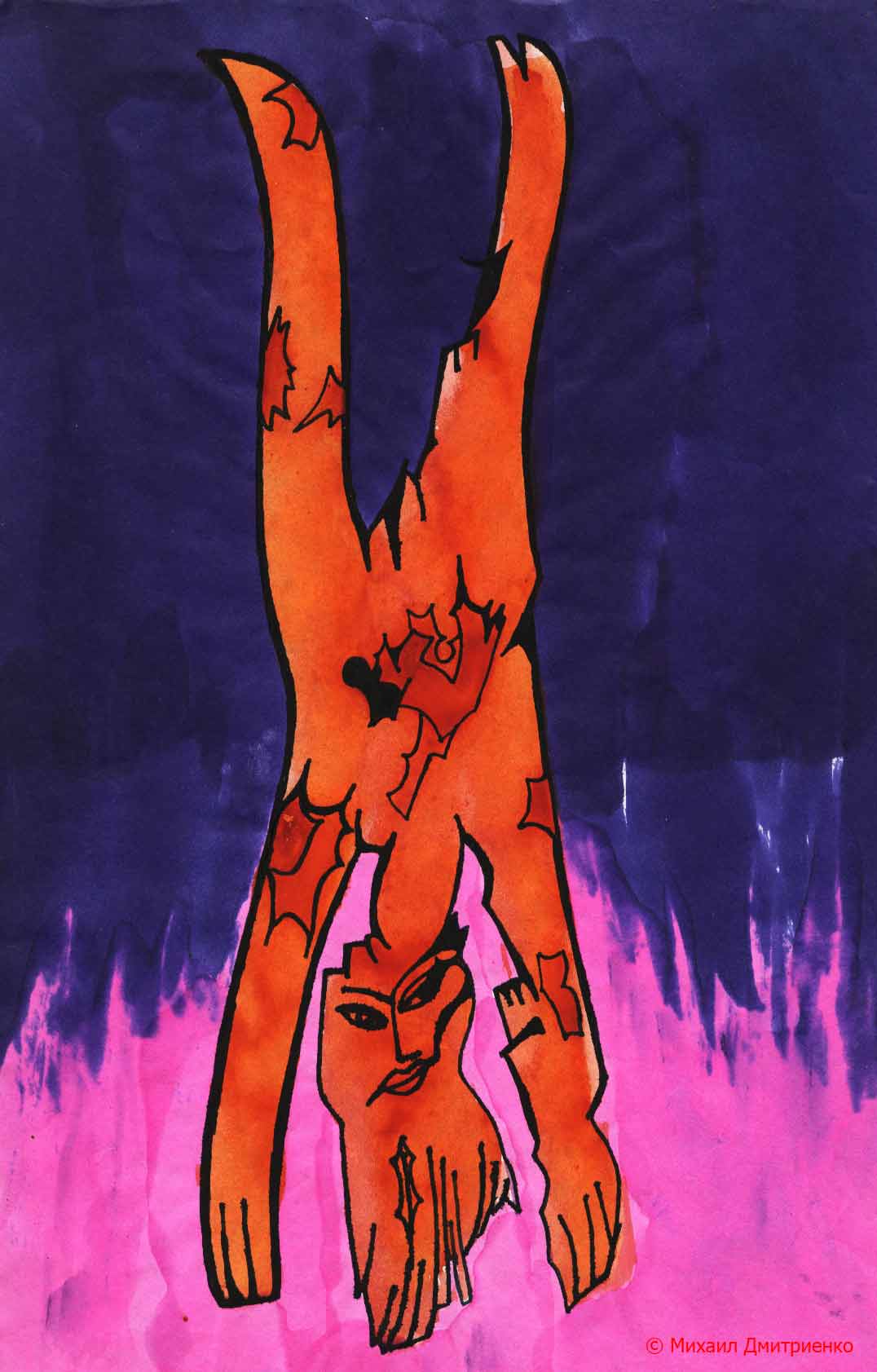 The writer's loneliness leaves him no choice; he is forced to live the lives of his fictional characters, since he has no other life. Gradually, I, too, became immersed in the worlds I myself had invented, immersed myself, and noticed with surprise that the more I was captivated by them, the less I could influence them. I, as the complete and utter master of the author, found myself a passive observer of what was happening, and to keep up with the fast-paced action, I was forced to skip after the characters, jotting down the gist of what I saw in a notebook as I went, like a scribbling journalist. At times, I rebelled and, like a capricious child, tried to take possession of my brainchild, my property. But, as I soon discovered, such "arbitrariness" did not go unpunished; The world born of my imagination perished from the mere thought of subjugating it to cold reason. The characters moved and talked for a while, the wheels of the cars spun, and the factories billowed smoke, but this world was already dead. It resembled streams of solidified volcanic lava or mannequins being moved from corner to corner. Eventually, even this world froze in unnatural poses, and my stories remained, as a rule, unfinished. The writer's loneliness leaves him no choice; he is forced to live the lives of his fictional characters, since he has no other life. Gradually, I, too, became immersed in the worlds I myself had invented, immersed myself, and noticed with surprise that the more I was captivated by them, the less I could influence them. I, as the complete and utter master of the author, found myself a passive observer of what was happening, and to keep up with the fast-paced action, I was forced to skip after the characters, jotting down the gist of what I saw in a notebook as I went, like a scribbling journalist. At times, I rebelled and, like a capricious child, tried to take possession of my brainchild, my property. But, as I soon discovered, such "arbitrariness" did not go unpunished; The world born of my imagination perished from the mere thought of subjugating it to cold reason. The characters moved and talked for a while, the wheels of the cars spun, and the factories billowed smoke, but this world was already dead. It resembled streams of solidified volcanic lava or mannequins being moved from corner to corner. Eventually, even this world froze in unnatural poses, and my stories remained, as a rule, unfinished.
It's very difficult to learn to create non-existent worlds, to create them as you dreamed, and not be a dictator within them. But only then can your imagination create a work — a Book. Otherwise, there are barren fantasies, heavy with the impossibility of realizing ideals, giving rise to anger at reality. And yet, what could be simpler than to compose harmony between contradictions, between unacceptable things? No literary genius can combine Love and Indifference into a single, beautiful whole—only a dreaming mediocrity can do that, and even "dreaming" is a grandiose expression, a drug addict's dream...
My dear friends constantly expect from me a stunning work of literature, like the works of Homer, Shakespeare, or Dostoevsky. They search for Truths in what I give them —I'm talking about manuscripts — conclusions equal in depth to the sayings of Buddha, Christ, or, for example, Friedrich Nische. I won't hide the fact that sometimes I follow their lead and squeeze out Words with which I seem to express my own Life Experience, but hardly a single reader will believe that there is nothing simpler and easier than creating "Holy Scripture" — an imitation of bookish wisdom... No, that is not the goal and genius of true writers; it lies elsewhere — n simplicity and ordinariness. "To flee from all Truths and all wisdom." He who can surprise with the most ordinary is a true artist. Only he who, in a dusty, decades-trampled street, will see and reveal unknown colors, imperceptible traits of harmony and beauty — he and only he is Great. The world has always been divided between those who contemplate the surrounding nature and those who contemplate themselves and seek answers within themselves. Nature is diverse, but united. The Self is one, but their great multitude, and this multitude of "I"s, is much more monotonous than they try to imagine. All people are driven by roughly the same thing, the basis of their actions and desires is one. Any introspection, if it aims to understand something, will still lead to the rejection of subjective assessments of one's own Self. And one can find oneself in emptiness, because only one "I" contemplates itself—itself, while that which provides answers is beyond one's field of vision. Our "I" consists of Nature, i.e., the entire surrounding world. And Truth is all of boundless Nature, of which someone's subjective "I" is the tiniest particle, and, "The small cannot explain the whole." "I am the alpha and omega..." are words that explain nothing, and therefore are empty. Nature doesn't scream with a billion voices: "I! I! I!" It is silent, but not mute; it is simply wiser than us, who are unaccustomed to thinking, unaccustomed to waiting, and who, instead of saying "I," say "We."
3
One man disliked money. He, like millions of his fellow citizens, was poor. There are people who love money — he hated it. And his dislike wasn't of the envious sort, like when a coward disparages courage, calling it stupidity and a non-existent thing, thereby compensating for his own shortcoming. Usually, what people don't have is criticized, to make life easier. But this eccentric said: "The greatest value of money isn't its purchasing power, not its backing by gold or state property, and certainly not in its quantity; its value is in the attitude toward it. It's disgusting, but the more they're loved, the more valuable they are. They may be candy wrappers, but love for them, for the very word "Money," will eclipse the insignificance of the piece of paper itself, eclipse it and elevate it above all the domes put together. For this love—the possession of money—a person is ready to do anything, ready to sell everything. Look, our planet has never known the kind of slavery that reigns today: people are no longer bought—they sell themselves, and are happy about it! This world, with its warped understanding of "what is good and what is bad," has strangled itself. The richest man is the greatest slave. The freest man is the poorest! I hate money because if I have it, I'm sold. My price is the price I paid for it...”
He was poor, and many rightfully asked, "How can one love or dislike something that one doesn't have, something one hasn't experienced?" And he answered, "Can there be a little love, a mild hatred? After all, you all don't have all the money in the world, so you, like me, judge relatively, and in the grand scheme of things, how much do you have to have to truly love or not love? No one has that kind of wealth; there is only a personal relationship to this world and to the money in this world—that is love or hate. "Everything we have, all our legal property, is OUR PERSONAL OPINION, and everything else is ours..."
He didn't love money and was poor, what an odd fellow—poverty was his, while he, as it turned out, was his FREEDOM. Only later, with illnesses and constant compromises, will nuances emerge and... well, that's the case with everyone.
4
When a person kills—when their mind crosses the line of what is permitted, or when their hand takes another's life? When a person cheats—when they swear fidelity without feeling love, or when they betray a friend, calculating their profit?
"A small sin—a small forgiveness, a great sin—a great forgiveness, a mortal sin—the Lord forgives. He doesn't forgive everyone..."
Lovers don't cheat on each other—those incapable of love cheat. To learn to love, one must learn to forgive, but is forgiveness really that important? "It's easy to forgive, not easy to forget." Who needs the formality of forgiveness? Everyone wants to forget! Forgot and that's it! Forgiveness is no longer required. But to forget is to neglect, to neglect the precious moments from which life and memory are woven! But to remember and forgive? To explain? To explain to oneself, to justify, to soften, to gloss over, and to say: "What was, can't be brought back. It's all in the past, and there's no point in devouring yourself or others—the day has passed, and that's it..." Isn't this fatalism, blind submission to fate, fear of the question: "Why?!" This is death, in a still-living soul, death only waiting for the grave to be ready. And our Love, our Hate, Memory, Forgiveness, Justification—all into the grave! Love is unattainably distant, for those who humiliated it, who once violated it, perhaps without realizing it, perhaps without realizing that this is Love...
No forgiveness can resurrect those who have sunk into oblivion. "I forgive you"—said out loud, silently, or even unspoken—is a cliché, a signature: "I remember everything, I feel hurt, but I forgive! My forgiveness is an acknowledgment of the pain that burns like a jagged wound in my heart." Such wounds never heal. The most inhumane weapon is betrayal. Such wounds cannot be forgiven, and there will be no more miracles...
5
The candle flame died down, and I fell asleep right there at the table, my head buried in the papers. I had dreams that I immediately forgot, but I knew what they were—in them, I endlessly flipped through and reread the pages of my memory—unwritten novels, short notes "about nothing," drafts and scattered pages of long-forgotten poems, all of it folded into one thick folder, which was then bound into a book. In it, I wanted to say... probably just one thing... but the meaning of that One, so true and clear before, now grew increasingly dense, and I saw only the sunrise, nearby mountains, and burgundy sunsets. I saw sunsets especially often... In the gathering twilight, horsemen raced off into the distance, clouds, birds, trees flew away, the stars faded, and sounds vanished...
in numbers. 13.1998 A-A. © Mikhail Dmitrienko |

